
About Brandin Cane Rods
Purpose
My intent in building cane rods is simply to make the finest rod that can be made, both in terms of craftsmanship and performance. This endeavor includes the evolution of design concepts relative to performance as well as aesthetic refinement and development.
I design rods with primarily two qualities in mind, smoothness and power. As an individual maker, I can design and build each rod exactly as I feel it should be. My annual rod production is, of necessity, very limited; please rest assured that when you purchase one of my rods, you are acquiring something truly unique with uncommon attention paid to its making.
Four Strip or Six Strip?
My intent in building cane rods is simply to make the finest rod that can be made, both in terms of craftsmanship and performance. This endeavor includes the evolution of design concepts relative to performance as well as aesthetic refinement and development.
I design rods with primarily two qualities in mind, smoothness and power. As an individual maker, I can design and build each rod exactly as I feel it should be. My annual rod production is, of necessity, very limited; please rest assured that when you purchase one of my rods, you are acquiring something truly unique with uncommon attention paid to its making.
Four Strip or Six Strip?
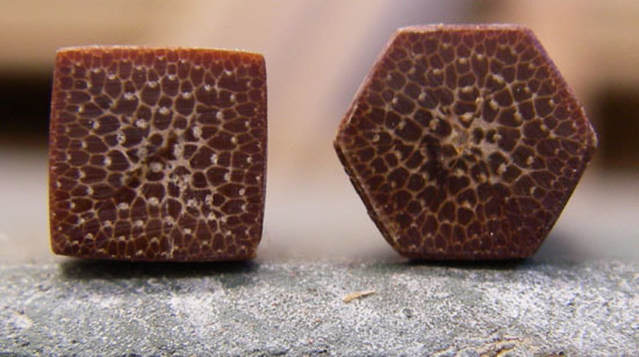
Cross sections of rods showing four and six strip configuration.
After starting out by making six strip rods, I soon became intrigued by the qualities of the four strip, square section rod. For the next ten years I built only four strip rods and it has been since 1995 that I have again made six strip rods.
I believed four strip rods would be more powerful than conventional six strip rods of the same length and weight. The difference in power between a four strip and a six strip rod is more subtle than it is dramatic, however, and the actual action and power of the rod is affected much more by the taper and by hollowbuilding than by choice of cross sectional design.
In a nutshell, the slightly greater power of the square section comes from the larger flats, which although slightly closer to the neutral axis of bending than on the six strip, are almost twice as wide (given equal volume of material). These wide flats also incorporate the densest power fibers of the cane. The engineers who I understand to have figured this out (in theory at least) have come up with a stiffness factor of .812 for the square section and of .791 for the hexagonal section and a maximum stress of 1.54 for the square as compared to 1.39 for the six strip. As I understand it these figures do not take into account the fact that bamboo is not a homogenous material. In fact, bamboo becomes much denser as the outside of the cane is approached. This makes the wide flats of the four strip rod, which incorporates a higher proportion of these fibers, of even more significance than if the material were of equal density throughout. Four strip rods seem to have a wider power band than a six strip rod, almost like the torque of a long stroke piston engine.
Contrary to popular belief, however, four strip rods require more work to make than a six strip, primarily due to the wider strips which must be worked with and the desirability of squaring the ferrule to fit the shape of the cane section. Finishing and wrapping guides is also more time consuming than on a six strip rod.
Although the four strip rod has certain advantages as outlined above, there is one type of rod in particular where the six strip design is more effective. If we want a long rod for a light line, such as an 8 1/2' rod for #5 line, or 8' for #3, where extreme light weight and delicacy are the desired qualities rather than power range, we can achieve this result more efficiently by using the same hollowbuilding methods I developed for my four strip rods on these six strip rods. The reason for this is that because of the geometry of the cross sections, I can remove a greater percentage of weight from the six strip rod than is possible with the square cross section. This is precisely what is required when making long rods for light lines. As a result of these insights, I am now building six strip rods again in a limited number of models.
Tapers
The taper of the bamboo shaft is the most important element by far that determines the action and performance of a fishing rod. All the tapers for my rods are my own and undergo continuous evolution and refinement. Arriving at a successful taper is a long process of trial and error which involves many interrelated factors. Whether fast or slow, parabolic or fast dry fly, the rod should act and feel as one unit. The preferred taper shape will vary with the type and size of flies expected to be used, line type and weight, stream size or if the rod will be fished primarily in lakes. Purely personal preference is of course a major factor.
My 'df' (dry fly) tapers are based on a traditional eastern taper where there is a swell as the cane comes out of the grip, a flattening taper to the mid, and then the taper getting steeper again as the tip top is approached. The 'P' taper has a regressive taper coming out of the grip, the greatest dimension actually being somewhere between the 10 to 15 inch point (measured from the butt), then a relatively flat taper continues to the ferrule (these are two piece rods) and then the tip has a steeper compound taper which ends in a sharp drop in the last 10 inches going into the tip top. Special order rods with no letter designation are semi-parabolic in action.
Generally speaking, my rods are faster in action than most other cane rods, and incorporate finer tips. Note that on hollowbuilt models, there is also an internal taper as well as the primary external taper.
Hollowbuilding
I believed four strip rods would be more powerful than conventional six strip rods of the same length and weight. The difference in power between a four strip and a six strip rod is more subtle than it is dramatic, however, and the actual action and power of the rod is affected much more by the taper and by hollowbuilding than by choice of cross sectional design.
In a nutshell, the slightly greater power of the square section comes from the larger flats, which although slightly closer to the neutral axis of bending than on the six strip, are almost twice as wide (given equal volume of material). These wide flats also incorporate the densest power fibers of the cane. The engineers who I understand to have figured this out (in theory at least) have come up with a stiffness factor of .812 for the square section and of .791 for the hexagonal section and a maximum stress of 1.54 for the square as compared to 1.39 for the six strip. As I understand it these figures do not take into account the fact that bamboo is not a homogenous material. In fact, bamboo becomes much denser as the outside of the cane is approached. This makes the wide flats of the four strip rod, which incorporates a higher proportion of these fibers, of even more significance than if the material were of equal density throughout. Four strip rods seem to have a wider power band than a six strip rod, almost like the torque of a long stroke piston engine.
Contrary to popular belief, however, four strip rods require more work to make than a six strip, primarily due to the wider strips which must be worked with and the desirability of squaring the ferrule to fit the shape of the cane section. Finishing and wrapping guides is also more time consuming than on a six strip rod.
Although the four strip rod has certain advantages as outlined above, there is one type of rod in particular where the six strip design is more effective. If we want a long rod for a light line, such as an 8 1/2' rod for #5 line, or 8' for #3, where extreme light weight and delicacy are the desired qualities rather than power range, we can achieve this result more efficiently by using the same hollowbuilding methods I developed for my four strip rods on these six strip rods. The reason for this is that because of the geometry of the cross sections, I can remove a greater percentage of weight from the six strip rod than is possible with the square cross section. This is precisely what is required when making long rods for light lines. As a result of these insights, I am now building six strip rods again in a limited number of models.
Tapers
The taper of the bamboo shaft is the most important element by far that determines the action and performance of a fishing rod. All the tapers for my rods are my own and undergo continuous evolution and refinement. Arriving at a successful taper is a long process of trial and error which involves many interrelated factors. Whether fast or slow, parabolic or fast dry fly, the rod should act and feel as one unit. The preferred taper shape will vary with the type and size of flies expected to be used, line type and weight, stream size or if the rod will be fished primarily in lakes. Purely personal preference is of course a major factor.
My 'df' (dry fly) tapers are based on a traditional eastern taper where there is a swell as the cane comes out of the grip, a flattening taper to the mid, and then the taper getting steeper again as the tip top is approached. The 'P' taper has a regressive taper coming out of the grip, the greatest dimension actually being somewhere between the 10 to 15 inch point (measured from the butt), then a relatively flat taper continues to the ferrule (these are two piece rods) and then the tip has a steeper compound taper which ends in a sharp drop in the last 10 inches going into the tip top. Special order rods with no letter designation are semi-parabolic in action.
Generally speaking, my rods are faster in action than most other cane rods, and incorporate finer tips. Note that on hollowbuilt models, there is also an internal taper as well as the primary external taper.
Hollowbuilding
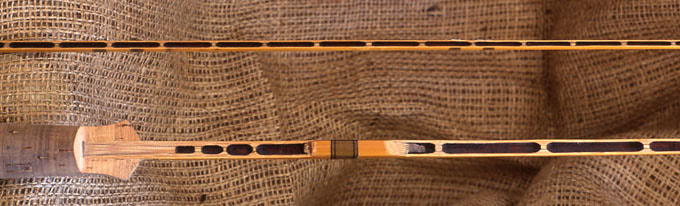
One of my earliest semi-hollow efforts completed in 1989, cut open to show the internal structure, including what I call my 'internal swell.'
I developed a system of hollowbuilding about 1988 (when I was still building rods in Pleasantville, NY) which allows me to build the tips as well as the butts hollow. This came about after a visit to the extraordinary California rod builder Mike Montagne who opened my eyes to the possibilities of hollow-building as well as a basic method for achieving it. The method I have since then developed is an evolution of E.C. Powell's basic ideas from the 1930's. Hollowing the tips has a major and beneficial impact on rod action even though the actual weight of bamboo removed from the tips is relatively small. Even the slightest change in weight or taper in the tip will have a major impact on the action and feel of the rod because the further towards the tip we move, the greater is the leverage of the weight that is there, and during the dynamic bending and recoiling of casting it is moving at a very much greater speed than is the butt. A rod hollowbuilt well into the tips throws tighter loops more easily and damps better because the tips have less inertia to overcome in casting. The power of the cane can be applied directly to the line rather than being used to overcome the inertia of the rod itself. My hollow building methods add an internal taper to the primary external taper of the rod. It is the subtle distribution of material in the rod which determines its action.
My hollowbuilt rods are alternately hollow and solid, the length of hollow and solid sections varying from one model to the next, and the wall thickness of bamboo getting smaller as the rodshaft gets slimmer going towards the tip. Tournament rods are more severely hollowed than are standard fishing rods. The last few inches going into the tip top are always solid, as is the cane going into and coming out of the ferrule stations. Other rod sections may also be left solid as desired to affect the action I desire for a given model. Most anglers and casters who have tried these hollowbuilt rods have been pleasantly surprised by their fast, smooth, easy dampening actions.
Heat Treating
A properly tempered rod will be more resilient and have less tendency to take a set than a rod which has not been tempered. Too much tempering can result in a brittle rod and can actually diminish the resiliency of the cane, however. Heat treating is one of many interrelated factors whose integrity and balance determine the action, longevity and character of the finished rod.
My hollowbuilt rods are alternately hollow and solid, the length of hollow and solid sections varying from one model to the next, and the wall thickness of bamboo getting smaller as the rodshaft gets slimmer going towards the tip. Tournament rods are more severely hollowed than are standard fishing rods. The last few inches going into the tip top are always solid, as is the cane going into and coming out of the ferrule stations. Other rod sections may also be left solid as desired to affect the action I desire for a given model. Most anglers and casters who have tried these hollowbuilt rods have been pleasantly surprised by their fast, smooth, easy dampening actions.
Heat Treating
A properly tempered rod will be more resilient and have less tendency to take a set than a rod which has not been tempered. Too much tempering can result in a brittle rod and can actually diminish the resiliency of the cane, however. Heat treating is one of many interrelated factors whose integrity and balance determine the action, longevity and character of the finished rod.
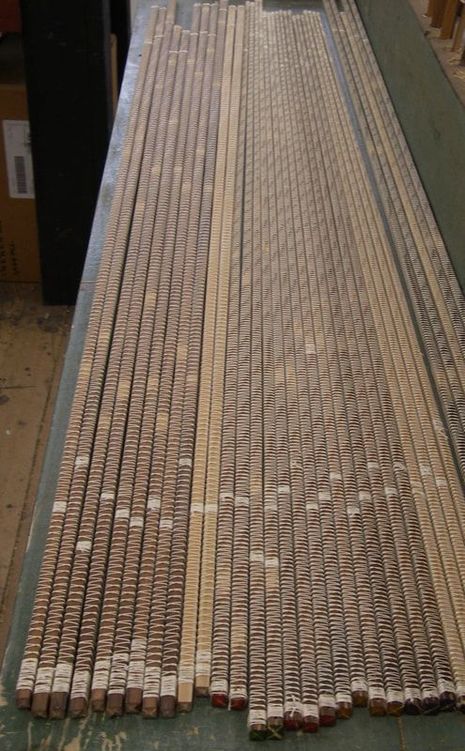
Rod sections preliminary milling complete and bound for secondary heat treatment.
Rod Fittings
Ferrules for my rods are machined from precision drawn nickel silver tubing. On four strip models, the ferrule is squared to match the taper of the rod. In this way, I can match ferrule dimension to the exact taper I desire, rather than having the taper determined by the ferrule size, which is necessitated on rods of more traditional design. When building semi-hollow six strip rods, I can balance the bamboo wall thickness to the dimension determined by the ferrule size to achieve the desired action.
Custom, in-house ferrule plugs are supplied with each rod.
Reelseats are of my own design and manufacture. Butt caps and slide bands are of nickel silver and are fitted over mahogany or spanish cedar spacers or cork if a skeleton seat is desired. On the lighter tapers (#4 line and lighter) a dual slide band skeleton seat may be ordered.
Ferrules for my rods are machined from precision drawn nickel silver tubing. On four strip models, the ferrule is squared to match the taper of the rod. In this way, I can match ferrule dimension to the exact taper I desire, rather than having the taper determined by the ferrule size, which is necessitated on rods of more traditional design. When building semi-hollow six strip rods, I can balance the bamboo wall thickness to the dimension determined by the ferrule size to achieve the desired action.
Custom, in-house ferrule plugs are supplied with each rod.
Reelseats are of my own design and manufacture. Butt caps and slide bands are of nickel silver and are fitted over mahogany or spanish cedar spacers or cork if a skeleton seat is desired. On the lighter tapers (#4 line and lighter) a dual slide band skeleton seat may be ordered.
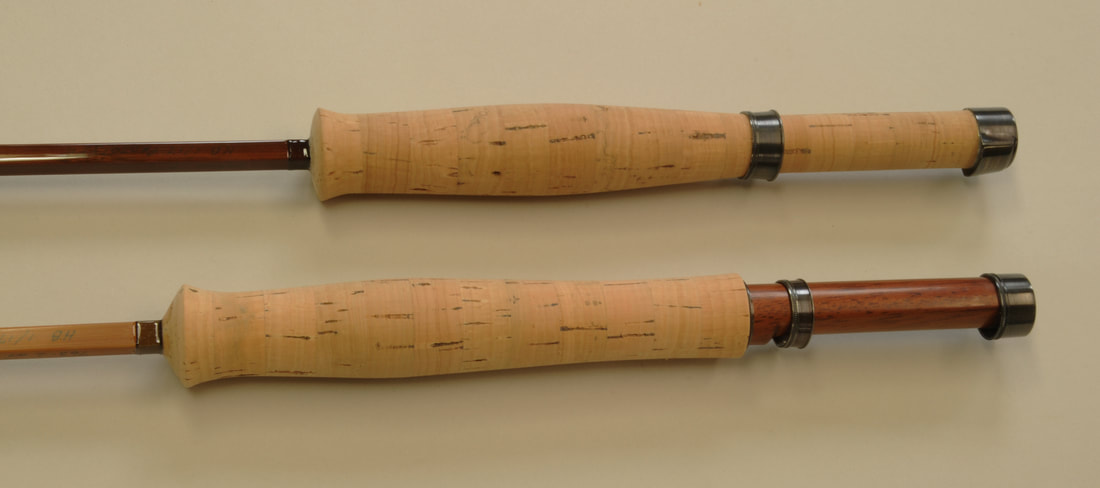
Top rod shown has an abbreviated 'Thomas style' grip with all-cork 'skeleton' reel-seat with wide slide-band and pocket butt cap; bottom rod has standard grip and mortised Mahogany cap & band reel-seat.
Locking polished aluminum reelseats are now available on rods for #5 lines and heavier. These may incorporate either a nickel silver or aluminum pocket butt cap.
Guides are dark, either titanium nitrate coated or light wire bronzed, depending on the rod model. I will also occasionally make a rod using old tungsten steel guides out of my stock of Mildrum or Perfection guides which are no longer in production. Most models will have agate stripping guides, though I will sometimes use Mildrum carbide ring strippers.
All rods are varnished with a top grade marine spar varnish hand rubbed to a satin, rather than a high gloss finish. I have gone back to this hand rubbed finish which is how I started finishing rods in the 1980's, shown to me by Hoagy Carmichael. I feel this type of finish, though a little more work, results in a rod less likely to spook fish with flashy reflections off the flats. Wraps are of silk, tipped at the grip, ferrules and tip top. A series of signature wraps are placed between the grip and stripping guide.
Guides are dark, either titanium nitrate coated or light wire bronzed, depending on the rod model. I will also occasionally make a rod using old tungsten steel guides out of my stock of Mildrum or Perfection guides which are no longer in production. Most models will have agate stripping guides, though I will sometimes use Mildrum carbide ring strippers.
All rods are varnished with a top grade marine spar varnish hand rubbed to a satin, rather than a high gloss finish. I have gone back to this hand rubbed finish which is how I started finishing rods in the 1980's, shown to me by Hoagy Carmichael. I feel this type of finish, though a little more work, results in a rod less likely to spook fish with flashy reflections off the flats. Wraps are of silk, tipped at the grip, ferrules and tip top. A series of signature wraps are placed between the grip and stripping guide.
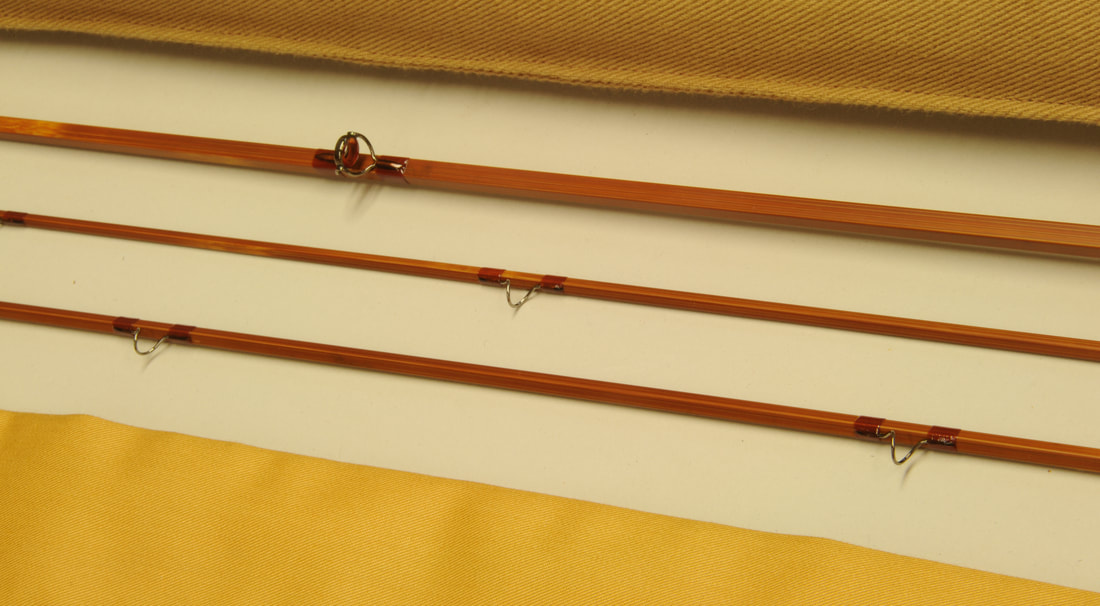
Rod tubes are of 6061 T6 heavy-walled aluminum tubing with custom brass end caps with felt inserts. The result is a much stronger tube than most of the commercially available ones. Heavy canvas tube sacks to protect the brass capped aluminum rod tube and label also keep the tubes from rattling against each other when transporting more than one rod in their tubes.
If you have any questions about specific rod models or generally on how my rods are made, don't hesitate to call. You may reach me at my shop in western Massachussetts by phone at (413) 625-6259 or by email at per2@comcast.net.
Other Materials and the Importance of Design
It is often thought that the big difference people felt between bamboo rods and fiberglass rods in the late 1950's and early 60's was due to a difference of materials used to make the blank. It was not; the most significant factor by far which accounted for the lighter feel of fiberglass rods was design. Solid bamboo rods were being compared to hollow fiberglass tubes. The first fiberglass rods were actually solid built and were heavy and unimpressive compared to bamboo. The early fiberglass rods were made from a fiberglass which was actually significantly lower modulus than bamboo, but when made into a hollow tube it made a light, responsive fishing rod.
By the mid 1970's when tubular glass design had evolved to a high degree, it prompted Doug Swisher and Carl Richards to make the following comment in their second book Fly Fishing Strategy (Crown Publishers 1975): "Modern, top grade glass rods are superior to top grade cane rods of any era."
It was in this environment that I began to study and eventually to build bamboo fly rods. I had become enchanted with the feel of bamboo and wanted to find ways to answer the challenge posed by fiberglass and then graphite. I looked for ways to increase the performance of bamboo and my first step was to turn to four strip, square section, or 'quad' rods as it seemed to me that this cross section would yield greater strength than the traditional hexagonal rod. This turned out to be true, but didn't give me the dramatic improvement I was looking for. It was my introduction to hollow-building, and most particularly hollow-building the tip, which provided the key to take advantage of the increased performance already seen in the hollow tubular synthetic rods. For this insight I owe a debt of gratitude to Michael Montagne who was the first rodmaker I know of to discuss hollow-built tips. A visit to his shop in the 1980's and reading his rod catalog opened my eyes to this possibility.
If you have any questions about specific rod models or generally on how my rods are made, don't hesitate to call. You may reach me at my shop in western Massachussetts by phone at (413) 625-6259 or by email at per2@comcast.net.
Other Materials and the Importance of Design
It is often thought that the big difference people felt between bamboo rods and fiberglass rods in the late 1950's and early 60's was due to a difference of materials used to make the blank. It was not; the most significant factor by far which accounted for the lighter feel of fiberglass rods was design. Solid bamboo rods were being compared to hollow fiberglass tubes. The first fiberglass rods were actually solid built and were heavy and unimpressive compared to bamboo. The early fiberglass rods were made from a fiberglass which was actually significantly lower modulus than bamboo, but when made into a hollow tube it made a light, responsive fishing rod.
By the mid 1970's when tubular glass design had evolved to a high degree, it prompted Doug Swisher and Carl Richards to make the following comment in their second book Fly Fishing Strategy (Crown Publishers 1975): "Modern, top grade glass rods are superior to top grade cane rods of any era."
It was in this environment that I began to study and eventually to build bamboo fly rods. I had become enchanted with the feel of bamboo and wanted to find ways to answer the challenge posed by fiberglass and then graphite. I looked for ways to increase the performance of bamboo and my first step was to turn to four strip, square section, or 'quad' rods as it seemed to me that this cross section would yield greater strength than the traditional hexagonal rod. This turned out to be true, but didn't give me the dramatic improvement I was looking for. It was my introduction to hollow-building, and most particularly hollow-building the tip, which provided the key to take advantage of the increased performance already seen in the hollow tubular synthetic rods. For this insight I owe a debt of gratitude to Michael Montagne who was the first rodmaker I know of to discuss hollow-built tips. A visit to his shop in the 1980's and reading his rod catalog opened my eyes to this possibility.
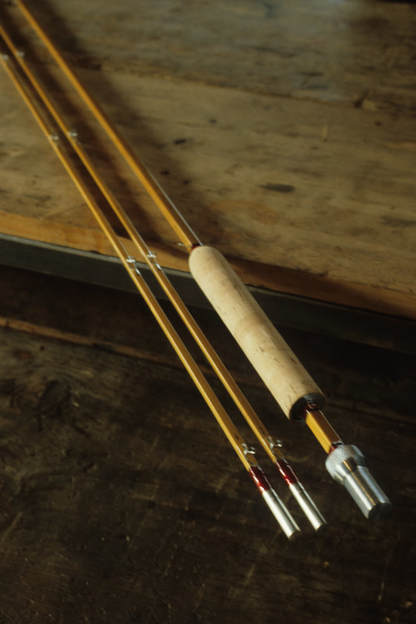
One of the unique rod creations photographed here in Michael Montagne's Olema, CA shop in the early 1980's.
Montagne referred in his catalog to the 'conventional hollow-building' of E.C. Powell and claimed greater removal of material by the Montagne process. Powell had been carrying his hollow-building into the tips since the 1930's, but Montagne was right that it's effectiveness was quite limited because of fairly heavy walls in the tips. In my first efforts at semi-hollow rods I wanted to see how far I could go and built four quad semi-hollow rods, all glued with resorcinol, and graduated the wall thicknesses as I went up the rods achieving progressively thinner walls. On the most radical tip hollowing I left a wall of only .012" (twelve thousandths of an inch). I left solid dams at regular intervals as a way for the strips to 'register' with each other during the glue-up process; it was only later that I realized that these solid dams also provided a crucial 'hoop strength' to the rod. Other builders I spoke with about what I was doing told me it would be impossible and if I could manage to build these hollow rods, they would break with the first cast. Thankfully they were wrong and the rods have held up very well.
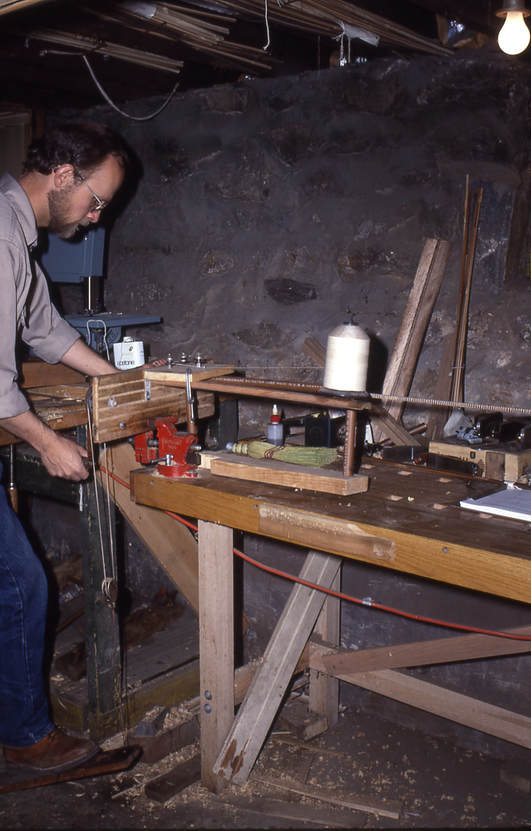
I here operate the rod binder in the Pleasantville basement shop about 1985. This binder was built to incorporate the main elements of the binder I had seen in Sam Carlson's shop, one which Sam had built similar to what F.E. Thomas and other traditional eastern shops used.
Since those early efforts in my basement in Pleasantville, NY this hollow-building has evolved, especially from the positive influence of Mario Wojnicki with whom I shared a shop for ten years in California. Using the tapered wall designs we had developed, we built rods for trout and steelhead fishing which we felt performed as well or better than any of the synthetic tubular rods.
A factor which contributed to the light feel of the top grade fiberglass rods of the 1960's and 70's was the development of the glass-to-glass ferrule which eliminated the weight of metal in the dynamic part of the rod. I personally have always preferred the internal 'spigot' design ferrule for glass rods, but the 'tip over' design popularized by Jimmy Green on his Fenwick Ferralite rods has the same effect of weight reduction. In 1995 I started using super short 'micro' Swiss style ferrules on my hollow-built six strip rods and found that they have a major beneficial effect on the action of the rod, both because of less weight and also less interference with the energy flow through the ferrule. Around the same time Mario Wojnicki developed and perfected his fiberglass ferrule for his five and six strip hollow-built bamboo rods. This of course had the same beneficial effect as it did on glass rods when they eliminated the weight of metal ferrules. Not long after I started using the micro ferrules for hexagonal rods, I began employing 'spliced joints' for joining my quad rods. This was an evolution of the old Scottish system for joining spey rods, translated for use on square section rods which as it turns out are a natural for joining with a splice. All of these design factors, hollow-building and the use of alternate joining systems have a hugely significant effect on the dynamics of the rod.
One of the earliest developers of hollow rods was Lew Stoner of the R.L. Winston Rod Co. In his patent papers we read: "the action of my improved fluted-hollow rod may be controlled at all points in its length as to stiffness, specific gravity and active cross section, by varying the depth, radius and shape of the fluting at any point therealong, and thus a rod may be designed to give any desired casting curvatures and action". Implicit in these concepts is the importance of taper, with the addition of hollow-building an internal as well as the always present external taper. It is now possible to make rods which challenge the supremacy in performance of even the finest graphite tubular rods. In fact, I would argue that we can fine-tune the action of a hollow-built bamboo rod much more precisely than manufacturers of tubular rods are willing to. It is much simpler for the small production bamboo builder to make incremental changes in dimensions to get exactly the action, feel and bending profile he wants, than it is for the larger manufacturer of tubular synthetic rods. One factor in favor of the bamboo builder is that the material itself is essentially not changing, while the graphite builders are constantly dealing with new resins, graphite cloth and scrim. The bamboo builder is free to concentrate on design without the confusion of changing materials. Bamboo is incredibly design friendly.
A factor which contributed to the light feel of the top grade fiberglass rods of the 1960's and 70's was the development of the glass-to-glass ferrule which eliminated the weight of metal in the dynamic part of the rod. I personally have always preferred the internal 'spigot' design ferrule for glass rods, but the 'tip over' design popularized by Jimmy Green on his Fenwick Ferralite rods has the same effect of weight reduction. In 1995 I started using super short 'micro' Swiss style ferrules on my hollow-built six strip rods and found that they have a major beneficial effect on the action of the rod, both because of less weight and also less interference with the energy flow through the ferrule. Around the same time Mario Wojnicki developed and perfected his fiberglass ferrule for his five and six strip hollow-built bamboo rods. This of course had the same beneficial effect as it did on glass rods when they eliminated the weight of metal ferrules. Not long after I started using the micro ferrules for hexagonal rods, I began employing 'spliced joints' for joining my quad rods. This was an evolution of the old Scottish system for joining spey rods, translated for use on square section rods which as it turns out are a natural for joining with a splice. All of these design factors, hollow-building and the use of alternate joining systems have a hugely significant effect on the dynamics of the rod.
One of the earliest developers of hollow rods was Lew Stoner of the R.L. Winston Rod Co. In his patent papers we read: "the action of my improved fluted-hollow rod may be controlled at all points in its length as to stiffness, specific gravity and active cross section, by varying the depth, radius and shape of the fluting at any point therealong, and thus a rod may be designed to give any desired casting curvatures and action". Implicit in these concepts is the importance of taper, with the addition of hollow-building an internal as well as the always present external taper. It is now possible to make rods which challenge the supremacy in performance of even the finest graphite tubular rods. In fact, I would argue that we can fine-tune the action of a hollow-built bamboo rod much more precisely than manufacturers of tubular rods are willing to. It is much simpler for the small production bamboo builder to make incremental changes in dimensions to get exactly the action, feel and bending profile he wants, than it is for the larger manufacturer of tubular synthetic rods. One factor in favor of the bamboo builder is that the material itself is essentially not changing, while the graphite builders are constantly dealing with new resins, graphite cloth and scrim. The bamboo builder is free to concentrate on design without the confusion of changing materials. Bamboo is incredibly design friendly.
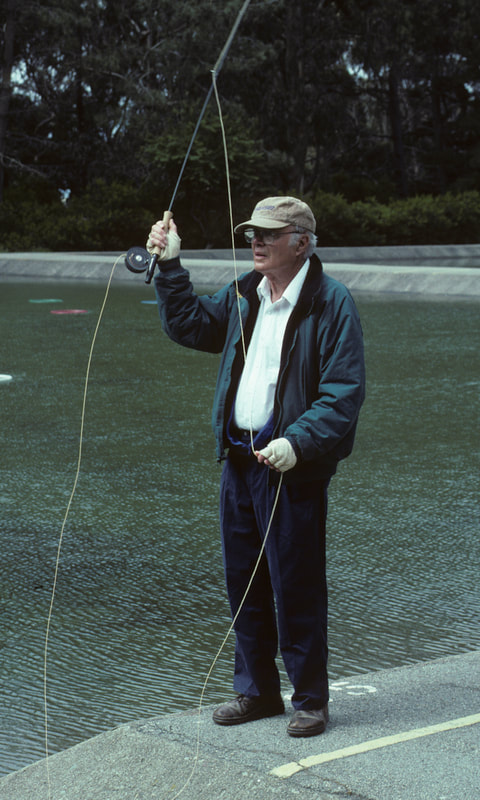
Jim Green at the Golden Gate Angling and Casting Club in the late 1990's casting one of his solid graphite rods.
Two makers of primarily tubular synthetic rods have had very interesting things to say about bamboo rods. One of these is Jimmy Green who for years was the Dean of tubular rod design. He got started with rods as a champion tournament caster at the Golden Gate Angling and Casting Club and worked for a short time with bamboo at the R.L. Winston Rod Co. just after WWII. He was a big fan of bamboo and of E.C. Powell, saying at one time in a printed interview that some of Powell's super fast rods were as fast as any graphite rod he had ever cast. Jim Green understood the importance of design and had great respect for well designed bamboo rods, though he spent almost his whole career at the cutting edge of synthetic manufacture. Towards the end of his life he was building graphite rods with solid tips, beause he said graphite had gotten so light and stiff it had lost its feel. He wanted the weight of solid tips to help the rod load under its own weight to regain some of the feel that had been lost in the chase for "lighter, stiffer, faster".
The other maker of note is Larry Kenney who was for years the president of Scott Rod Co. He one time said to me that for rods of 8 feet and under, both bamboo and fiberglass are better materials for a fishing rod than graphite. That was at a time when Scott was making nothing but graphite rods. I very much agree with him; I feel most short graphite rods are an abomination (there are exceptions, such as the old Sage LL series of rods; the 7'9" for #3 line was superb). Everything happens too fast; feel is lost and there is little control of the line and fly, compared to the slower, self-loading actions of the lower modulus materials. I believe this is part of the reason there is currently a resurgence of fiberglass. Larry is today making highly evolved glass rods after retiring from Scott many years ago and Scott now has an excellent line of fiberglass rods. Tom Morgan is in the process of producing a wonderful smooth feeling series of glass rods from 7' to 8'6" and Mario Wojnicki makes some of the best casting glass rods I've ever tried. Mike McFarland is now also producing wonderful, smooth casting glass rods in Pennsylvania.
Where graphite, because of its extremely light weight, does shine is in very long rods for light lines. Examples would be a nine foot #3 line rod, or the 10½ foot rods for #4 or 5 lines many people prefer out of float tubes, or the very long 'trout spey' rods now being developed. These rods fall outside of the type of rod I choose to fish with, maybe because of my admitted prejudice for bamboo.
For me, bamboo is the ideal material for making fly rods. With proper use and balance of design concepts such as hollow-building, reduced weight joining methods, and cutting edge component use, I never any more feel the need to reach for graphite. This is true for me even of two handed rods up to 13 ft. and 9 ft. #10 weight Tarpon rods. With all this talk of cutting edge design and innovation, however, we should not lose track of the ever present importance of taper. There is still room for new taper work and for fine-tuning actions. It often amazes me when I pick up some of the rods made of solid bamboo from 1915 to about 1930; the wonderful feel and line control they have is astonishing and this was achieved with nothing but solid bamboo and a great understanding of tapers. My favorite 7 foot #3 line rod was built by Eustis Edwards in the teens of the last century.
The other maker of note is Larry Kenney who was for years the president of Scott Rod Co. He one time said to me that for rods of 8 feet and under, both bamboo and fiberglass are better materials for a fishing rod than graphite. That was at a time when Scott was making nothing but graphite rods. I very much agree with him; I feel most short graphite rods are an abomination (there are exceptions, such as the old Sage LL series of rods; the 7'9" for #3 line was superb). Everything happens too fast; feel is lost and there is little control of the line and fly, compared to the slower, self-loading actions of the lower modulus materials. I believe this is part of the reason there is currently a resurgence of fiberglass. Larry is today making highly evolved glass rods after retiring from Scott many years ago and Scott now has an excellent line of fiberglass rods. Tom Morgan is in the process of producing a wonderful smooth feeling series of glass rods from 7' to 8'6" and Mario Wojnicki makes some of the best casting glass rods I've ever tried. Mike McFarland is now also producing wonderful, smooth casting glass rods in Pennsylvania.
Where graphite, because of its extremely light weight, does shine is in very long rods for light lines. Examples would be a nine foot #3 line rod, or the 10½ foot rods for #4 or 5 lines many people prefer out of float tubes, or the very long 'trout spey' rods now being developed. These rods fall outside of the type of rod I choose to fish with, maybe because of my admitted prejudice for bamboo.
For me, bamboo is the ideal material for making fly rods. With proper use and balance of design concepts such as hollow-building, reduced weight joining methods, and cutting edge component use, I never any more feel the need to reach for graphite. This is true for me even of two handed rods up to 13 ft. and 9 ft. #10 weight Tarpon rods. With all this talk of cutting edge design and innovation, however, we should not lose track of the ever present importance of taper. There is still room for new taper work and for fine-tuning actions. It often amazes me when I pick up some of the rods made of solid bamboo from 1915 to about 1930; the wonderful feel and line control they have is astonishing and this was achieved with nothing but solid bamboo and a great understanding of tapers. My favorite 7 foot #3 line rod was built by Eustis Edwards in the teens of the last century.
